
Lesson No 1: Risk Assessment and Management
Risk Assessment and Management is a fundamental element of effective workplace health and safety systems, providing a structured approach for identifying hazards, evaluating risks, and implementing suitable control measures to prevent accidents and protect workers. In industries such as construction, engineering, maintenance, and industrial operations, effective risk assessment enables organisations to understand potential dangers associated with workplace activities and develop practical solutions before incidents occur. This lesson introduces learners to the principles of risk identification, risk evaluation, control strategies, and continuous monitoring to support safer working environments.
This lesson explores how safety professionals and supervisors apply risk assessment techniques to analyse workplace conditions, assess the likelihood and severity of hazards, and select appropriate preventive measures. Learners will develop an understanding of the importance of hazard recognition, workplace inspections, risk control planning, and reviewing safety arrangements to ensure they remain effective. The content focuses on practical workplace applications, helping learners understand how risk management processes support compliance with occupational health and safety requirements and improve overall safety performance.
Through this lesson, learners will gain the knowledge and skills required to participate effectively in workplace risk assessment activities, identify unsafe conditions, and contribute to proactive safety management. By understanding risk assessment and management principles, workers and supervisors can make informed decisions, reduce workplace hazards, and support the development of a strong safety culture across various industries.
1. Develop the Ability to Identify Potential Hazards Associated with Working at Height
Introduction to Hazard Identification in Work at Height Activities
Working at height remains one of the most significant risk areas in construction, mechanical engineering, maintenance, manufacturing, and industrial operations. Falls from elevated locations, falling objects, unstable access equipment, and unsuitable working conditions can result in severe injuries, equipment damage, project delays, and operational failures. Therefore, the ability to identify potential hazards before starting work is a fundamental skill for safety professionals, supervisors, engineers, and workers involved in elevated activities.
From a QA/QC Mechanical Engineering perspective, hazard identification is not only a safety requirement but also an essential part of quality assurance and operational control. A well-structured hazard identification process ensures that work activities are planned correctly, equipment reliability is maintained, safety standards are followed, and defects or unsafe conditions are identified before they affect project performance. Mechanical systems, lifting equipment, scaffolding structures, access platforms, and temporary installations must all be assessed to ensure they are suitable for safe operation.
This lesson develops learners’ understanding of how to recognise hazards associated with working at height, evaluate their potential impact, and apply appropriate prevention strategies. It focuses on practical workplace situations, risk identification techniques, and the importance of proactive safety management. By developing strong hazard identification skills, learners can contribute to safer workplaces, improved compliance, and more effective risk control systems.
Understanding Hazards Associated with Working at Height
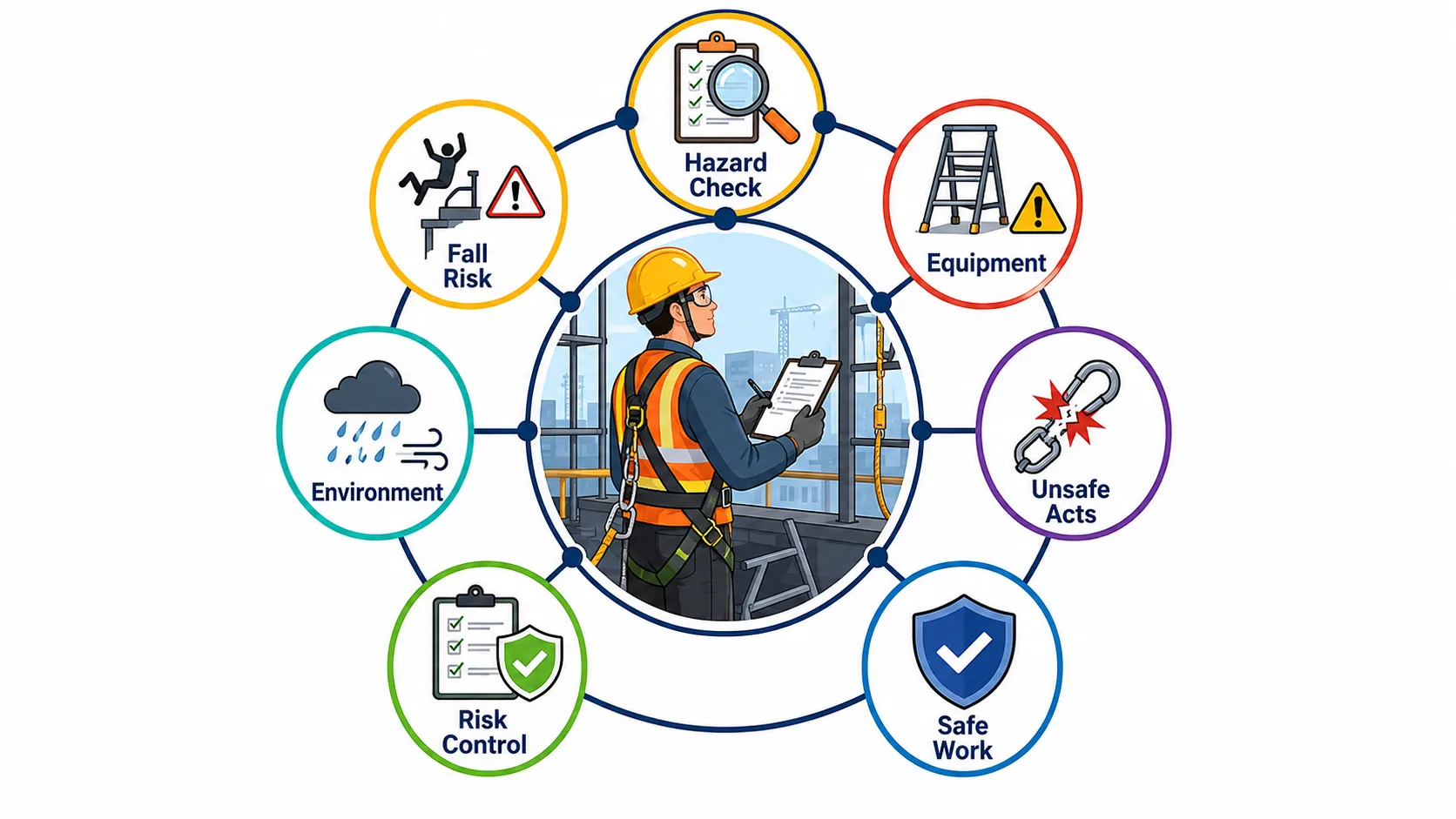
A hazard is any condition, activity, object, or situation that has the potential to cause harm to people, equipment, property, or the environment. In work at height activities, hazards may exist due to unsafe equipment, poor planning, environmental conditions, human behaviour, or inadequate control measures.
Hazard identification is the first stage of the risk assessment process. Before workers access elevated areas, safety professionals must identify possible sources of danger and determine how those hazards may affect the task.
Key purposes of hazard identification include:
- Preventing accidents before they occur.
- Understanding workplace conditions.
- Selecting suitable control measures.
- Improving safety planning.
- Supporting legal compliance.
- Reducing workplace incidents and losses.
Effective hazard identification requires observation, technical knowledge, workplace experience, and understanding of safety regulations.
Key Concepts Related to Work at Height Hazards
| Key Concept | Definition | Importance in Work at Height Safety |
|---|---|---|
| Hazard | A source or situation with potential to cause harm | Helps identify unsafe conditions before work begins |
| Risk | The likelihood that a hazard will cause harm and the severity of consequences | Supports decision-making and control selection |
| Hazard Identification | The process of finding and recognising potential dangers | Forms the foundation of risk assessment |
| Control Measure | An action taken to eliminate or reduce risk | Prevents accidents and protects workers |
| Fall Hazard | A condition where a person may fall from an elevated position | Requires specific prevention strategies |
| Safe System of Work | A planned method for completing tasks safely | Ensures consistent workplace practices |
Common Types of Hazards Associated with Working at Height
Fall Hazards
Falls are the most serious and common hazards associated with working at height. They can occur when workers lose balance, access equipment fails, protective barriers are missing, or working surfaces are unstable.
Examples of fall hazards include:
- Unprotected edges.
- Open platforms.
- Roof openings.
- Fragile surfaces.
- Unsafe ladders.
- Incomplete scaffolding.
- Poor access routes.
Fall hazards can result in:
- Serious injuries.
- Permanent disability.
- Fatal accidents.
- Damage to equipment and structures.
Workers and supervisors must identify fall hazards before beginning any elevated activity and implement suitable controls.
Unsafe Access Equipment Hazards
Access equipment provides workers with a means of reaching elevated areas, but incorrect selection or poor maintenance can create significant risks.
Examples include:
- Damaged ladders.
- Incorrect ladder positioning.
- Unstable mobile platforms.
- Defective scaffolding components.
- Overloaded access equipment.
A QA/QC mechanical engineer must ensure that equipment used for access is:
- Suitable for the intended task.
- Properly inspected.
- Maintained according to requirements.
- Operated by competent personnel.
Equipment Failure Hazards
Mechanical equipment failure can create serious risks during work at height activities. Equipment such as lifting platforms, scaffolding systems, and support structures must perform reliably.
Potential causes of equipment failure include:
- Poor maintenance.
- Excessive loading.
- Material deterioration.
- Incorrect assembly.
- Manufacturing defects.
Quality control inspections help identify equipment issues before they create safety risks.
Falling Object Hazards
Objects falling from height can injure workers below and damage machinery, materials, or structures.
Common causes include:
- Poor material storage.
- Unsecured tools.
- Loose components.
- Inadequate barriers.
- Poor housekeeping.
Preventive measures include:
- Securing tools.
- Establishing exclusion zones.
- Installing protective barriers.
- Maintaining organised work areas.
Environmental Hazards
Workplace conditions can significantly affect safety during work at height.
Environmental hazards include:
- Strong winds.
- Rain and wet surfaces.
- Poor lighting.
- Extreme temperatures.
- Dust and visibility problems.
Before starting work, supervisors should evaluate environmental conditions and determine whether work can proceed safely.
Electrical Hazards During Work at Height
Many work at height activities occur near electrical systems, creating additional risks.
Electrical hazards may include:
- Contact with overhead power lines.
- Damaged electrical equipment.
- Incorrect isolation procedures.
- Poor cable management.
Workers should consider:
- Electrical isolation requirements.
- Safe distances.
- Competency requirements.
- Protective systems.
Human Factors and Behavioural Hazards
Human behaviour plays a major role in workplace incidents. Even with effective equipment and procedures, unsafe decisions can increase risk.
Common behavioural hazards include:
- Ignoring safety procedures.
- Taking shortcuts.
- Lack of communication.
- Poor concentration.
- Inadequate training.
Developing a strong safety culture helps reduce human-factor risks.
Hazard Identification Process for Working at Height
A systematic process ensures that hazards are identified effectively.
Step 1: Understand the Work Activity
Before identifying hazards, professionals should understand:
- The task requirements.
- Work location.
- Equipment involved.
- Number of workers.
- Duration of work.
For example, installing mechanical equipment on a roof requires different hazard considerations compared with cleaning windows from an elevated platform.
Step 2: Inspect the Workplace Area
A physical inspection should identify possible dangers.
During inspection, consider:
- Access points.
- Working surfaces.
- Equipment condition.
- Surrounding hazards.
- Environmental conditions.
Step 3: Identify Potential Hazards
Workers and supervisors should ask:
- What could cause a fall?
- What equipment could fail?
- What objects could fall?
- What environmental conditions could create risks?
Step 4: Evaluate Risk Levels
After identifying hazards, the next step is evaluating:
- Likelihood of occurrence.
- Severity of consequences.
- Number of people exposed.
High-risk hazards require immediate control measures.
Step 5: Implement Control Measures
Controls should follow the principle of reducing risks as much as possible.
Control methods include:
- Eliminating unnecessary work at height.
- Using safer access methods.
- Installing protective barriers.
- Providing suitable PPE.
- Improving training and supervision.
Practical Example 1: Mechanical Installation at Height
A mechanical engineering team needs to install ventilation equipment on the roof of a commercial building.
During hazard identification, the team identifies:
- Risk of falling from roof edges.
- Heavy equipment lifting hazards.
- Weather-related risks.
- Unstable access routes.
The team applies controls by:
- Installing edge protection.
- Using approved lifting equipment.
- Checking weather conditions.
- Providing trained personnel.
This demonstrates how hazard identification supports safe project execution.
Practical Example 2: Scaffold Inspection Before Use
A maintenance contractor plans to use scaffolding for equipment repairs.
The inspection identifies:
- Missing guardrails.
- Loose scaffold components.
- Poor access arrangements.
The work is stopped until corrective actions are completed.
This example shows the importance of identifying hazards before workers are exposed to danger.
Role of QA/QC Mechanical Engineers in Hazard Identification
QA/QC mechanical engineers play an important role in ensuring workplace safety and quality standards are maintained.
Their responsibilities include:
- Reviewing work procedures.
- Inspecting mechanical equipment.
- Verifying compliance with specifications.
- Identifying defects and unsafe conditions.
- Monitoring corrective actions.
Quality inspections support safety by ensuring that equipment and systems operate as intended.
Benefits of Effective Hazard Identification
Benefits for Workers
Effective hazard identification provides:
- Improved safety awareness.
- Reduced exposure to dangerous conditions.
- Better understanding of workplace risks.
- Increased confidence during tasks.
Benefits for Organisations
Organisations benefit through:
- Fewer workplace accidents.
- Improved legal compliance.
- Reduced project delays.
- Lower operational costs.
- Better safety reputation.
Benefits for Quality Management Systems
Hazard identification supports:
- Improved inspection processes.
- Better documentation.
- Stronger risk control.
- Continuous improvement.
Best Practices for Identifying Work at Height Hazards
Organisations should follow these best practices:
- Conduct regular workplace inspections.
- Involve workers in hazard reporting.
- Review previous incidents.
- Maintain equipment inspection records.
- Provide continuous safety training.
- Update risk assessments regularly.
Conclusion
The ability to identify potential hazards associated with working at height is a fundamental requirement for maintaining safe and efficient workplace operations. Effective hazard identification allows organisations to recognise risks before they become incidents and implement suitable control measures to protect workers, equipment, and project performance.
From a QA/QC mechanical engineering perspective, hazard identification supports both safety and quality objectives by ensuring that equipment, procedures, and workplace conditions meet required standards. By understanding fall hazards, equipment risks, environmental factors, and human behaviours, professionals can make informed decisions that improve workplace safety.
Developing strong hazard identification skills enables learners to contribute effectively to risk assessment processes, comply with occupational safety requirements, and support safer work environments across construction, mechanical engineering, maintenance, and industrial sectors.
2. Conduct Comprehensive Risk Assessments for Tasks Involving Height Work
Introduction to Risk Assessment for Work at Height Activities
Conducting comprehensive risk assessments for tasks involving height work is a critical responsibility within occupational health and safety management, particularly in construction, mechanical engineering, industrial maintenance, and engineering projects. Work at height activities involve significant hazards because even a small error in planning, equipment selection, or execution can result in serious injuries, equipment damage, project delays, or operational failures. A structured risk assessment process enables organisations to identify hazards, evaluate potential risks, and implement effective control measures before workers are exposed to danger.
From a QA/QC Mechanical Engineering perspective, risk assessment is not only a safety requirement but also an essential quality management activity. Mechanical systems, temporary structures, lifting equipment, access platforms, scaffolding, and installation processes must be evaluated to ensure they meet safety, reliability, and performance expectations. A comprehensive risk assessment helps quality professionals verify that work methods, equipment conditions, and operational procedures comply with project specifications, regulatory requirements, and industry best practices.
This lesson develops learners’ understanding of how to perform detailed risk assessments for work at height activities. It explains the principles of hazard identification, risk evaluation, control selection, monitoring, and continuous improvement. Learners will explore practical assessment methods, workplace scenarios, and professional approaches used by safety specialists and QA/QC engineers to ensure that height-related tasks are completed safely and efficiently.
Understanding the Purpose of Comprehensive Risk Assessment
A comprehensive risk assessment is a systematic process used to identify hazards, analyse risks, and determine appropriate measures to protect workers and workplace operations. For work at height activities, risk assessments are essential because hazards can change depending on the location, equipment, environmental conditions, and complexity of the task.
The main purpose of conducting a detailed risk assessment is to:
Prevent accidents before they occur.
Identify unsafe conditions and behaviours.
Determine appropriate control measures.
Ensure compliance with health and safety requirements.
Improve workplace planning and decision-making.
Protect workers, equipment, and project assets.
A well-developed risk assessment allows organisations to move from reactive safety management, where actions are taken after incidents occur, to proactive risk prevention.
Key Concepts of Work at Height Risk Assessment
| Key Concept | Definition | Importance in Work at Height Management |
|---|---|---|
| Risk Assessment | A structured process of identifying hazards and evaluating risks associated with an activity | Helps determine necessary safety controls |
| Hazard Identification | The process of recognising potential sources of harm | Prevents unsafe conditions from being overlooked |
| Risk Evaluation | Assessing the likelihood and severity of potential incidents | Supports informed safety decisions |
| Control Measures | Actions implemented to eliminate or reduce risks | Minimises the possibility of accidents |
| Residual Risk | The remaining risk after control measures are applied | Helps determine if work can proceed safely |
| Dynamic Assessment | Continuous evaluation of changing workplace conditions | Ensures safety during changing situations |
Importance of Comprehensive Risk Assessments in Height Work
Work at height tasks are often affected by changing conditions. A risk assessment completed at the beginning of a project may not remain effective if equipment, weather, workers, or working conditions change.
Comprehensive risk assessments help organisations consider:
The nature of the task.
The working environment.
Equipment requirements.
Worker competence.
Emergency arrangements.
Possible changes during the activity.
For example, a mechanical installation task at height may involve lifting heavy components, working near electrical systems, and operating access equipment. Each factor must be considered to ensure the activity is properly controlled.
Risk Assessment Process for Work at Height Activities
A professional risk assessment follows a structured process to ensure all hazards are identified and controlled.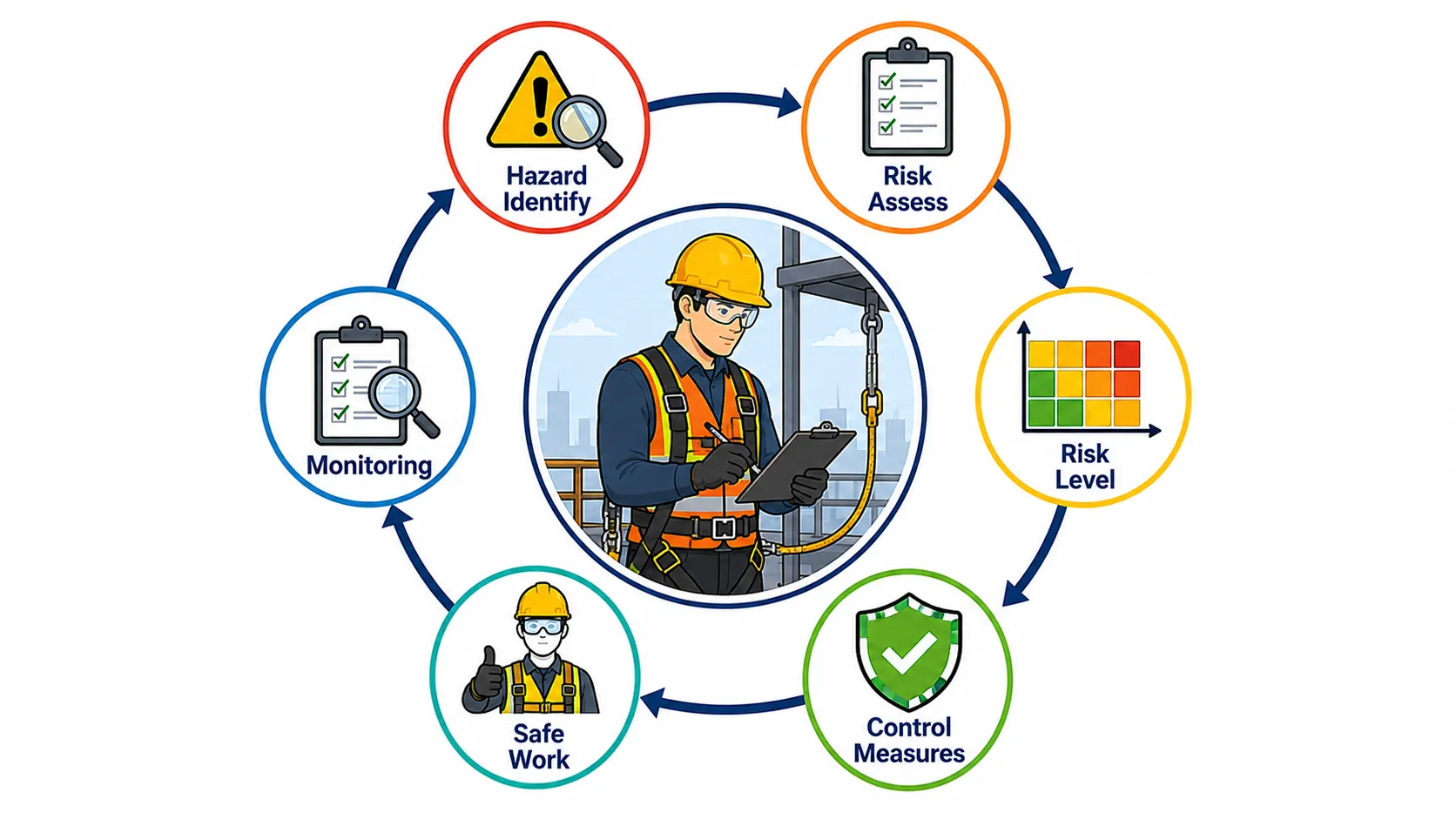
Step 1: Define the Work Activity
The first stage is understanding exactly what work will be performed.
The assessment should consider:
Purpose of the task.
Location of the work.
Height involved.
Duration of the activity.
Number of workers involved.
Equipment required.
Environmental conditions.
For example, installing mechanical ventilation equipment on a building roof requires consideration of access methods, lifting arrangements, weather conditions, and worker protection systems.
Step 2: Identify Potential Hazards
The next stage involves identifying anything that could cause harm during the activity.
Common work at height hazards include:
Fall Hazards
Examples include:
Unprotected edges.
Open floor areas.
Roof openings.
Fragile surfaces.
Poor access routes.
Equipment Hazards
Examples include:
Damaged ladders.
Unsafe scaffolding.
Faulty lifting equipment.
Incorrectly assembled platforms.
Environmental Hazards
Examples include:
Strong winds.
Rain.
Poor lighting.
Extreme temperatures.
Human Factors
Examples include:
Lack of training.
Poor communication.
Unsafe shortcuts.
Failure to follow procedures.
Step 3: Determine Risk Levels
After identifying hazards, the assessor must evaluate the level of risk.
Risk evaluation normally considers:
Likelihood
How likely is the incident to occur?
Factors include:
Frequency of exposure.
Workplace conditions.
Equipment reliability.
Worker competence.
Severity
How serious would the consequences be?
Possible outcomes include:
Minor injuries.
Serious injuries.
Permanent disability.
Fatality.
A combination of likelihood and severity helps determine the priority level of each risk.
Step 4: Select Appropriate Control Measures
After evaluating risks, suitable controls must be selected.
The hierarchy of controls should be considered.
Eliminate the Hazard
The safest option is removing the need for work at height.
Examples:
Completing assembly at ground level.
Using remote inspection methods.
Reduce Exposure
Where height work cannot be avoided:
Limit time at height.
Reduce the number of workers exposed.
Improve task planning.
Use Engineering Controls
Examples include:
Guardrails.
Safe platforms.
Edge protection.
Permanent access systems.
Apply Administrative Controls
Examples include:
Permit systems.
Safe work procedures.
Training requirements.
Supervision.
Use Personal Protective Equipment (PPE)
Examples include:
Safety harnesses.
Fall arrest systems.
Protective helmets.
Step 5: Review and Communicate the Assessment
A risk assessment is only effective if the information is communicated to everyone involved.
Workers should understand:
Identified hazards.
Required control measures.
Safe working methods.
Emergency procedures.
Communication methods may include:
Toolbox talks.
Safety briefings.
Work instructions.
Training sessions.
Role of QA/QC Mechanical Engineers in Risk Assessment
QA/QC mechanical engineers contribute significantly to effective risk assessment by ensuring that technical requirements and safety expectations are achieved.
Their responsibilities may include:
Reviewing engineering drawings.
Checking equipment suitability.
Inspecting mechanical systems.
Verifying installation procedures.
Monitoring compliance with specifications.
Recording inspection findings.
A QA/QC engineer ensures that unsafe conditions are identified before they affect workers or project quality.
Practical Example 1: Mechanical Equipment Installation at Height
Scenario
A mechanical engineering team must install a large ventilation unit on the roof of an industrial facility.
Identified Risks
The risk assessment identifies:
Falling from roof edges.
Dropping mechanical components.
Lifting equipment failure.
Poor weather conditions.
Control Measures Applied
The organisation implements:
Edge protection systems.
Approved lifting equipment.
Trained operators.
Weather monitoring.
Exclusion zones.
Outcome
The task is completed safely because risks were identified and controlled before work started.
Practical Example 2: Maintenance Work Using Elevated Platforms
Scenario
A maintenance team uses a mobile elevated work platform to repair industrial machinery.
Risk Assessment Considerations
The assessment reviews:
Platform stability.
Operator competence.
Ground conditions.
Overhead hazards.
Emergency procedures.
Controls Implemented
The team ensures:
Equipment inspection before use.
Proper operator training.
Safe operating procedures.
Continuous supervision.
This demonstrates how risk assessment supports safe maintenance activities.
Dynamic Risk Assessment During Height Work
Workplace conditions can change during a task, requiring continuous evaluation.
A dynamic risk assessment involves reviewing:
Weather changes.
Equipment condition.
Worker behaviour.
Unexpected hazards.
Examples of situations requiring reassessment:
Sudden strong winds.
Damaged equipment discovered during work.
Change in work location.
Additional workers entering the area.
Dynamic assessment ensures safety decisions remain effective throughout the activity.
Documentation Requirements for Risk Assessments
Proper documentation provides evidence that risks have been considered and controlled.
Risk assessment records should include:
Task description.
Identified hazards.
Risk ratings.
Control measures.
Responsible persons.
Review dates.
Good documentation supports:
Legal compliance.
Workplace communication.
Incident investigations.
Continuous improvement.
Common Mistakes in Work at Height Risk Assessments
Poor risk assessments can create unsafe working conditions.
Common mistakes include:
Copying previous assessments without review.
Ignoring changing conditions.
Focusing only on equipment.
Failing to involve workers.
Selecting ineffective controls.
Not updating assessments after incidents.
Avoiding these mistakes improves workplace safety performance.
Benefits of Conducting Comprehensive Risk Assessments
Benefits for Workers
Effective risk assessments provide:
Increased safety awareness.
Reduced exposure to hazards.
Better understanding of procedures.
Improved confidence during tasks.
Benefits for Organisations
Organisations benefit through:
Reduced accidents.
Improved compliance.
Better project control.
Reduced downtime.
Improved safety culture.
Benefits for QA/QC Management Systems
Risk assessments support:
Better inspection planning.
Improved quality control.
Stronger documentation.
Improved operational reliability.
Best Practices for Effective Risk Assessment
Organisations should follow these professional practices:
Involve experienced workers in assessments.
Review risks before every major task.
Consider equipment limitations.
Monitor workplace conditions.
Maintain accurate records.
Update assessments regularly.
Provide appropriate training.
Conclusion
Conducting comprehensive risk assessments for tasks involving height work is essential for preventing accidents, protecting workers, and maintaining safe operational environments. A detailed assessment allows organisations to identify hazards, evaluate risks, and implement effective control measures before work begins.
From a QA/QC mechanical engineering perspective, risk assessment supports both safety and quality objectives by ensuring that equipment, procedures, and workplace conditions meet required standards. Through systematic planning, hazard identification, risk evaluation, and continuous monitoring, organisations can improve compliance and reduce workplace incidents.
By developing strong risk assessment skills, learners can contribute effectively to workplace safety management and support safer work practices across construction, mechanical engineering, maintenance, and industrial environments.
3. Implement Effective Risk Control Measures to Mitigate Identified Risks
Introduction to Risk Control Measures in Work at Height Activities
Implementing effective risk control measures is a critical stage in the work at height risk management process. After hazards have been identified and risks have been assessed, organisations must introduce suitable control measures to eliminate hazards where possible or reduce risks to an acceptable level. Effective risk control ensures that workers, equipment, and workplace operations are protected from potential harm while maintaining compliance with occupational health and safety requirements.
From the perspective of a Senior Health and Safety Professional and Work at Height Safety Specialist, risk controls must be practical, reliable, and appropriate for the specific workplace situation. Selecting the correct control measure requires an understanding of the task, working environment, equipment limitations, worker competence, and possible emergency situations. Poorly selected controls may create additional risks, while properly implemented measures can significantly reduce workplace accidents and improve safety performance.
For learners studying the ICTQual Level 1 Award in Work at Height, understanding how to implement risk controls develops essential workplace safety skills. This knowledge enables learners to apply prevention strategies, support safe systems of work, and contribute to safer construction, engineering, maintenance, and industrial environments.
Understanding Risk Control Measures
Risk control measures are actions or systems introduced to remove hazards or reduce the likelihood and severity of workplace incidents. In work at height activities, controls are designed to prevent falls, protect workers from falling objects, improve equipment safety, and ensure tasks are completed using safe methods.
A successful risk control approach follows the principle of controlling risks before work begins rather than relying only on personal protection after hazards exist.
The main objectives of risk control measures include:
Eliminating unnecessary exposure to height-related hazards.
Preventing falls from elevated locations.
Reducing the severity of possible incidents.
Improving workplace safety conditions.
Supporting legal and regulatory compliance.
Protecting workers, equipment, and property.
Key Concepts of Risk Control in Work at Height
| Key Concept | Definition | Importance in Risk Management |
|---|---|---|
| Risk Control | Actions taken to remove or reduce workplace risks | Helps prevent accidents and injuries |
| Hierarchy of Controls | A structured approach for selecting the most effective safety measures | Ensures risks are controlled effectively |
| Elimination | Removing the hazard completely from the workplace | Provides the highest level of protection |
| Engineering Controls | Physical changes that reduce exposure to hazards | Provides reliable protection systems |
| Administrative Controls | Procedures, training, and instructions used to manage risks | Supports safe worker behaviour |
| Personal Protective Equipment (PPE) | Equipment worn by workers to reduce exposure to hazards | Provides additional protection when other controls cannot fully remove risks |
Applying the Hierarchy of Controls for Work at Height
The hierarchy of controls provides a systematic method for selecting effective safety measures. Organisations should always consider the highest level of control first before relying on personal protective equipment.
Elimination of Work at Height Risks
Elimination is the most effective method because it removes the hazard completely.
Examples include:
Completing assembly work at ground level.
Using remote inspection technology.
Designing equipment access points at ground level.
Prefabricating components before installation.
For example, a mechanical engineering company may assemble pipe sections on the ground before lifting them into position. This reduces the need for workers to perform assembly tasks at height.
Benefits of elimination include:
Complete removal of exposure.
Reduced dependence on worker behaviour.
Improved productivity.
Lower accident potential.
Substitution of Unsafe Methods
Substitution involves replacing a hazardous method with a safer alternative.
Examples include:
Replacing ladders with mobile access platforms.
Using automated systems instead of manual height work.
Selecting safer equipment designs.
Substitution reduces risk by changing the method of completing the task.
Engineering Control Measures
Engineering controls involve physical changes that provide protection without relying heavily on individual worker actions.
Common engineering controls include:
Guardrails and Edge Protection
Guardrails prevent workers from accidentally falling from exposed edges.
They are commonly used on:
Roof areas.
Platforms.
Walkways.
Temporary structures.
Safety Platforms
Properly designed platforms provide stable working surfaces and reduce the likelihood of falls.
They should:
Support required loads.
Have safe access.
Include protective barriers.
Scaffolding Systems
Scaffolding provides temporary working access for construction and maintenance activities.
Effective scaffold controls include:
Correct installation.
Regular inspections.
Suitable access points.
Proper load management.
Mechanical Access Equipment
Equipment such as mobile elevated work platforms can provide safer access compared with unsuitable climbing methods.
Controls include:
Operator training.
Equipment inspection.
Safe operating procedures.
Administrative Control Measures
Administrative controls focus on managing worker activities through planning, procedures, and communication.
Important administrative controls include:
Safe Systems of Work
A safe system of work provides clear instructions for completing tasks safely.
It should include:
Task procedures.
Hazard information.
Equipment requirements.
Emergency actions.
Worker responsibilities.
Training and Competence
Workers must have appropriate knowledge and skills before performing work at height.
Training should cover:
Hazard recognition.
Equipment use.
Safety procedures.
Emergency response.
Correct PPE usage.
Competent workers are more capable of identifying risks and applying safe practices.
Permit-to-Work Systems
Permit systems provide formal approval before high-risk activities begin.
They help ensure:
Risks are reviewed.
Controls are implemented.
Responsible persons are identified.
Safety conditions are maintained.
Supervision and Monitoring
Supervision ensures that workers follow approved procedures and safety requirements.
Effective supervision includes:
Workplace observations.
Safety discussions.
Correcting unsafe behaviour.
Reviewing changing conditions.
Personal Protective Equipment as a Risk Control
Personal protective equipment provides additional protection when risks cannot be completely eliminated through other controls.
Common PPE for work at height includes:
Safety helmets.
Full-body harnesses.
Lanyards.
Fall arrest systems.
Safety footwear.
However, PPE should not be the first choice of control because it depends on correct worker use.
Effective PPE management requires:
Correct equipment selection.
Worker training.
Regular inspections.
Proper maintenance.
Correct storage.
Risk Control Implementation Process
Implementing effective controls requires a planned approach.
Step 1: Review Identified Risks
Before selecting controls, organisations should review:
Hazard type.
Risk severity.
Number of workers exposed.
Working conditions.
Equipment requirements.
This ensures controls address the actual workplace risks.
Step 2: Select Suitable Control Measures
The selected controls should:
Reduce risk effectively.
Be practical for the task.
Meet safety requirements.
Consider worker capability.
Step 3: Communicate Control Requirements
Workers must understand:
What controls are required.
How equipment should be used.
What procedures must be followed.
Communication methods may include:
Toolbox talks.
Safety briefings.
Work instructions.
Training sessions.
Step 4: Implement and Monitor Controls
After implementation, organisations must check whether controls are working effectively.
Monitoring activities include:
Safety inspections.
Equipment checks.
Worker observations.
Incident reviews.
Step 5: Review and Improve Controls
Risk controls should be reviewed regularly to ensure continued effectiveness.
Reviews may be required when:
Work conditions change.
New equipment is introduced.
Incidents occur.
Regulations are updated.
Practical Example 1: Roof Maintenance Risk Control
Scenario
A maintenance team needs to repair equipment installed on a commercial building roof.
Identified Risks
The risk assessment identifies:
Fall from roof edges.
Slippery surfaces.
Dropped tools.
Poor weather conditions.
Implemented Controls
The organisation applies:
Edge protection systems.
Safe access routes.
Tool securing methods.
Weather monitoring.
Worker training.
Outcome
The controls reduce the likelihood of falls and ensure workers complete the task safely.
Practical Example 2: Mechanical Installation at Height
Scenario
A mechanical contractor installs ventilation equipment inside an industrial facility.
Potential Risks
Workers falling from platforms.
Equipment dropping during lifting.
Incorrect access equipment.
Risk Controls
The company introduces:
Approved lifting plans.
Certified access platforms.
Competent operators.
Inspection procedures.
This demonstrates how effective controls protect both workers and project quality.
Role of Safety Professionals in Risk Control Implementation
Senior health and safety professionals play an important role in ensuring that risk controls are suitable and effective.
Their responsibilities include:
Reviewing risk assessments.
Advising on control selection.
Monitoring workplace compliance.
Conducting inspections.
Supporting safety improvement.
They ensure that risk control decisions are based on evidence, legislation, and industry best practice.
Benefits of Effective Risk Control Measures
Benefits for Workers
Effective controls provide:
Increased workplace protection.
Reduced accident risks.
Greater confidence during tasks.
Improved safety awareness.
Better understanding of procedures.
Benefits for Organisations
Organisations benefit through:
Reduced workplace incidents.
Improved compliance.
Lower accident-related costs.
Better productivity.
Stronger safety culture.
Benefits for Quality and Safety Management Systems
Risk controls support:
Improved operational reliability.
Better documentation.
Stronger inspection processes.
Continuous improvement.
Improved project performance.
Common Challenges in Implementing Risk Controls
Organisations may face challenges such as:
Selecting unsuitable controls.
Poor communication.
Lack of worker training.
Failure to monitor effectiveness.
Changing workplace conditions.
These challenges can be reduced through effective planning, communication, and continuous review.
Best Practices for Effective Risk Control Management
Organisations should:
Follow the hierarchy of controls.
Involve workers in safety planning.
Review controls regularly.
Maintain equipment properly.
Provide ongoing training.
Encourage hazard reporting.
Promote a proactive safety culture.
Conclusion
Implementing effective risk control measures is essential for managing work at height hazards and preventing workplace accidents. After identifying and assessing risks, organisations must select appropriate controls that eliminate hazards where possible and reduce remaining risks through engineering controls, administrative procedures, and personal protective equipment.
For learners completing the ICTQual Level 1 Award in Work at Height, understanding risk control implementation develops practical safety skills required for real workplace situations. By applying effective control measures, safety professionals, supervisors, and workers can improve compliance, protect employees, and create safer working environments across construction, mechanical engineering, maintenance, and industrial sectors.
4. Utilize the Hierarchy of Controls to Prioritize Safety Interventions
Introduction to the Hierarchy of Controls in Work at Height Safety
The hierarchy of controls is a fundamental principle used by health and safety professionals to identify and select the most effective methods for reducing workplace risks. In work at height activities, where falls, equipment failure, and unsafe conditions can result in serious injuries or fatalities, applying the hierarchy of controls ensures that safety interventions are prioritised according to their effectiveness rather than relying only on personal protective equipment.
From the perspective of a Senior Health and Safety Professional and Work at Height Safety Specialist, the hierarchy of controls provides a structured decision-making approach for eliminating hazards, reducing exposure, and protecting workers. It encourages organisations to address the source of risk before depending on worker behaviour or individual protective measures. This approach supports legal compliance, improves workplace safety performance, and creates a proactive safety culture.
For learners completing the ICTQual Level 1 Award in Work at Height, understanding the hierarchy of controls is essential for developing practical risk management skills. It enables learners to recognise why some safety measures are more effective than others and how to select appropriate interventions when planning and controlling height-related activities.
Understanding the Hierarchy of Controls
The hierarchy of controls is a systematic framework that ranks safety interventions from the most effective to the least effective. The principle behind this approach is that removing or reducing hazards at the source provides stronger protection than relying only on individual worker actions.
The hierarchy normally follows this order:
- Elimination
- Substitution
- Engineering Controls
- Administrative Controls
- Personal Protective Equipment (PPE)
The higher levels of the hierarchy provide greater protection because they reduce reliance on human behaviour, memory, and decision-making.
Key Concepts of the Hierarchy of Controls
| Key Concept | Definition | Importance in Work at Height Safety |
|---|---|---|
| Hierarchy of Controls | A structured method for selecting safety measures based on effectiveness | Helps prioritise the strongest risk reduction methods |
| Elimination | Removing the hazard completely from the workplace | Provides the highest level of protection |
| Substitution | Replacing a hazardous activity or method with a safer alternative | Reduces exposure to dangerous conditions |
| Engineering Controls | Physical systems designed to separate workers from hazards | Provides reliable and consistent protection |
| Administrative Controls | Procedures, training, and instructions used to manage risks | Improves worker awareness and safe behaviour |
| Personal Protective Equipment | Protective equipment worn by workers to reduce injury risk | Provides final protection when other controls cannot fully remove hazards |
Importance of Prioritizing Safety Interventions
Not all safety controls provide the same level of protection. Organisations that rely mainly on PPE may still expose workers to significant risks because PPE depends on correct selection, fitting, inspection, and worker behaviour.
Prioritising safety interventions helps organisations:
- Remove hazards before work begins.
- Reduce dependency on individual actions.
- Improve workplace reliability.
- Strengthen safety management systems.
- Prevent accidents more effectively.
- Meet legal and regulatory expectations.
For example, preventing workers from needing to access a roof by redesigning equipment placement is more effective than simply providing a safety harness.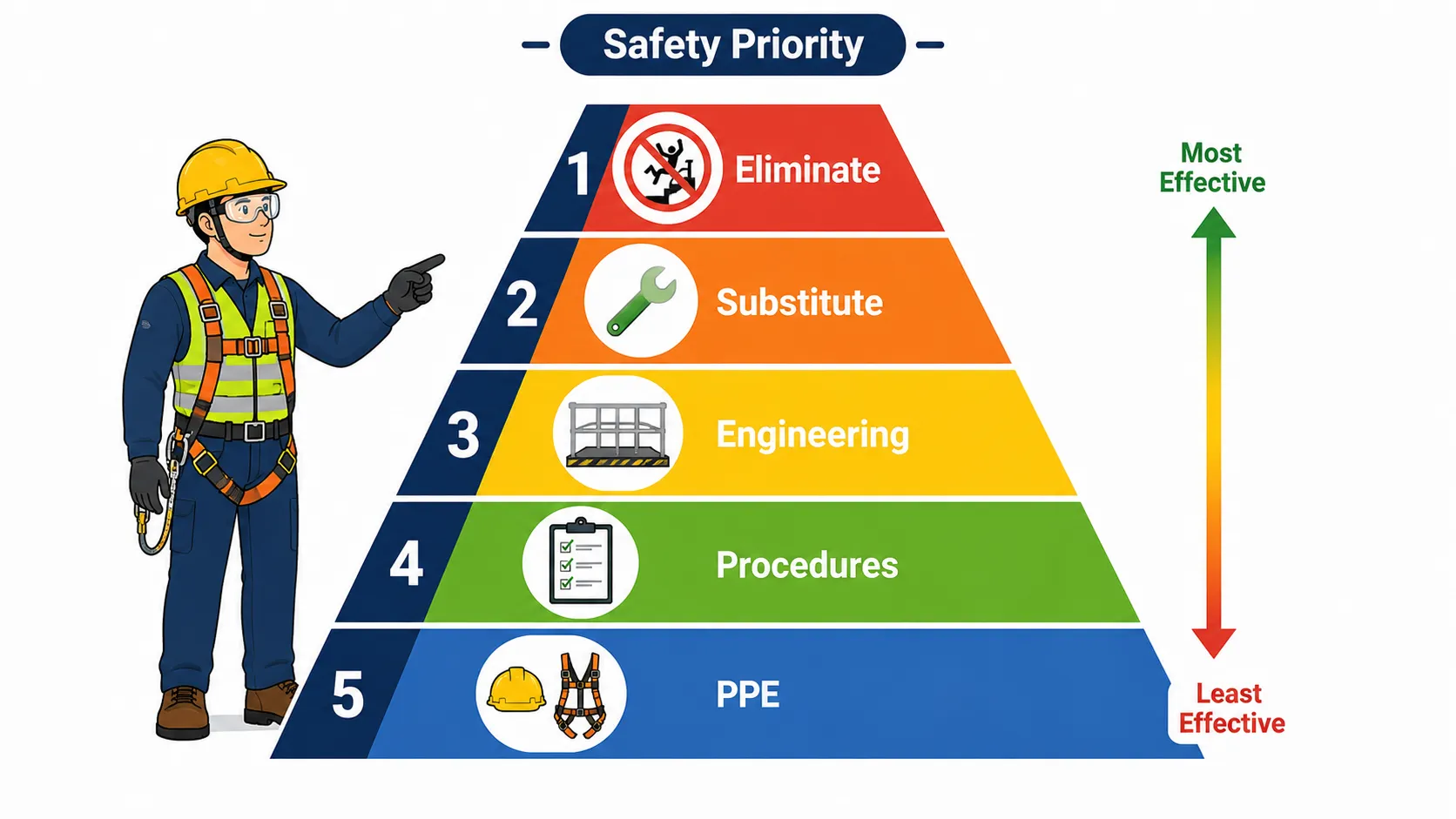
Level 1: Elimination of Hazards
Elimination is the highest level of control because it completely removes the hazard from the workplace. When a hazard no longer exists, workers are no longer exposed to the associated risk.
In work at height activities, elimination should always be considered before introducing other controls.
Examples of elimination include:
- Performing work at ground level.
- Installing equipment before construction reaches height.
- Using remote inspection technology.
- Designing buildings with safer maintenance access.
- Prefabricating components at ground level.
Practical Example: Ground-Level Assembly
A mechanical contractor needs to install pipework inside an industrial building. Instead of assembling sections on elevated platforms, the company prepares components at ground level and lifts the completed assembly into position.
Benefits:
- Workers spend less time at height.
- Fall risks are removed.
- Installation efficiency improves.
- Safety requirements are reduced.
Elimination provides the strongest protection because it removes the possibility of exposure.
Level 2: Substitution of Safer Methods
Substitution involves replacing a hazardous method, process, or equipment with a safer alternative. While the hazard may not be completely removed, the level of risk is reduced.
Examples of substitution include:
- Replacing ladders with mobile platforms.
- Using mechanical lifting systems instead of manual handling at height.
- Selecting safer access equipment.
- Using longer-lasting and more reliable materials.
Practical Example: Replacing Ladders
A maintenance team regularly uses ladders to access equipment located several metres above ground. The organisation replaces ladder use with a mobile elevated work platform.
Advantages include:
- Improved worker stability.
- Reduced fall potential.
- Better working conditions.
- Increased task efficiency.
Substitution is often a practical option when complete elimination is not possible.
Level 3: Engineering Controls
Engineering controls involve designing or modifying the workplace to physically reduce exposure to hazards. These controls are highly effective because they provide protection without requiring constant worker decision-making.
Common engineering controls for work at height include:
Guardrails and Edge Protection
Guardrails prevent workers from accidentally falling from exposed edges.
Applications include:
- Roof areas.
- Platforms.
- Walkways.
- Elevated working surfaces.
Benefits:
- Continuous protection.
- Reduced reliance on PPE.
- Suitable for multiple workers.
Safety Platforms
Properly designed platforms provide stable working areas and reduce risks associated with climbing or balancing.
Requirements include:
- Adequate strength.
- Safe access.
- Protective barriers.
- Regular inspections.
Scaffolding Systems
Scaffolding provides temporary access for construction and maintenance tasks.
Effective scaffold controls include:
- Correct assembly.
- Competent inspection.
- Proper loading.
- Secure access routes.
Mechanical Access Equipment
Examples include:
- Mobile elevated work platforms.
- Hydraulic platforms.
- Powered access systems.
These systems reduce the need for unsafe climbing methods.
Level 4: Administrative Controls
Administrative controls focus on managing work activities through procedures, communication, and worker behaviour. Although they are important, they are less effective than elimination or engineering controls because they depend on people following instructions correctly.
Examples of administrative controls include:
- Risk assessments.
- Safe work procedures.
- Training programmes.
- Permit-to-work systems.
- Warning signs.
- Safety briefings.
Safe Work Procedures
A safe work procedure explains how a task should be completed safely.
It should include:
- Task requirements.
- Identified hazards.
- Required equipment.
- Worker responsibilities.
- Emergency actions.
Training and Competence
Workers must understand:
- How to identify hazards.
- How to use equipment.
- How to follow procedures.
- How to respond during emergencies.
Training improves worker confidence and reduces unsafe actions.
Permit-to-Work Systems
Permit systems ensure that high-risk activities are reviewed before work begins.
They confirm:
- Hazards have been assessed.
- Controls are implemented.
- Responsible persons are identified.
- Work conditions are acceptable.
Level 5: Personal Protective Equipment (PPE)
PPE is the final level in the hierarchy of controls. It protects workers when hazards cannot be completely eliminated or controlled through other methods.
Examples of work at height PPE include:
- Safety helmets.
- Full-body harnesses.
- Shock-absorbing lanyards.
- Fall arrest systems.
- Safety footwear.
Although PPE is important, it should not be the first solution because effectiveness depends on correct use.
PPE management requires:
- Correct selection.
- Worker training.
- Regular inspection.
- Proper maintenance.
- Suitable storage.
Applying the Hierarchy of Controls in Risk Management
The hierarchy should be applied during the risk assessment process.
The process includes:
Step 1: Identify the Hazard
Determine what could cause harm.
Examples:
- Open edges.
- Unsafe access.
- Falling objects.
- Equipment failure.
Step 2: Consider Elimination First
Ask:
- Can the task be completed without working at height?
- Can the design be changed?
- Can equipment be installed differently?
Step 3: Select the Highest Practical Control
If elimination is not possible:
- Consider substitution.
- Apply engineering controls.
- Introduce administrative measures.
- Use PPE as additional protection.
Step 4: Review Effectiveness
Monitor whether controls are working.
Review:
- Workplace conditions.
- Worker feedback.
- Inspection results.
- Incident information.
Practical Case Study: Construction Roof Installation
Scenario
A construction company needs to install mechanical equipment on the roof of a commercial building.
Initial Risk
Workers may fall while positioning equipment near roof edges.
Applying the Hierarchy of Controls
Elimination:
- Prefabricate equipment sections at ground level.
Substitution:
- Use a mechanical lifting system instead of manual carrying.
Engineering Controls:
- Install temporary edge protection.
Administrative Controls:
- Provide work instructions and safety briefings.
PPE:
- Use harnesses where additional protection is required.
Outcome
The company reduces exposure to hazards and creates a safer installation process.
Role of Safety Professionals in Prioritising Controls
Senior safety professionals are responsible for ensuring that organisations select effective interventions.
Their responsibilities include:
- Reviewing risk assessments.
- Advising on control selection.
- Checking compliance.
- Evaluating workplace conditions.
- Promoting continuous improvement.
They ensure that organisations do not rely only on lower-level controls when stronger solutions are available.
Benefits of Using the Hierarchy of Controls
Benefits for Workers
Effective prioritisation provides:
- Reduced exposure to hazards.
- Improved workplace protection.
- Greater confidence.
- Safer working conditions.
Benefits for Organisations
Organisations achieve:
- Fewer accidents.
- Improved compliance.
- Reduced operational disruption.
- Better safety performance.
- Stronger safety culture.
Benefits for Safety Management Systems
The hierarchy supports:
- Better risk management.
- Improved decision-making.
- More effective prevention strategies.
- Continuous improvement.
Common Mistakes When Applying the Hierarchy of Controls
Organisations may reduce effectiveness by:
- Using PPE as the first solution.
- Ignoring elimination opportunities.
- Selecting unsuitable controls.
- Failing to review controls.
- Not involving workers.
Avoiding these mistakes ensures safety interventions provide maximum protection.
Conclusion
The hierarchy of controls provides a structured approach for prioritising safety interventions in work at height activities. By focusing first on eliminating hazards and then applying substitution, engineering controls, administrative controls, and PPE, organisations can achieve stronger and more reliable risk reduction.
For learners completing the ICTQual Level 1 Award in Work at Height, understanding this hierarchy develops essential safety management skills. It enables workers and supervisors to make informed decisions, select appropriate controls, and contribute to safer workplaces across construction, engineering, maintenance, and industrial environments.
Applying the hierarchy of controls effectively helps organisations move from reactive accident response to proactive prevention, improving safety performance and protecting workers from height-related hazards.