Lexiton International
Lexiton International Welcome to Lexiton International
Courses › LICQual Level 3 Certificate in Quality Control and Quality Assurance (QA/QC) in Mechanical Engineering

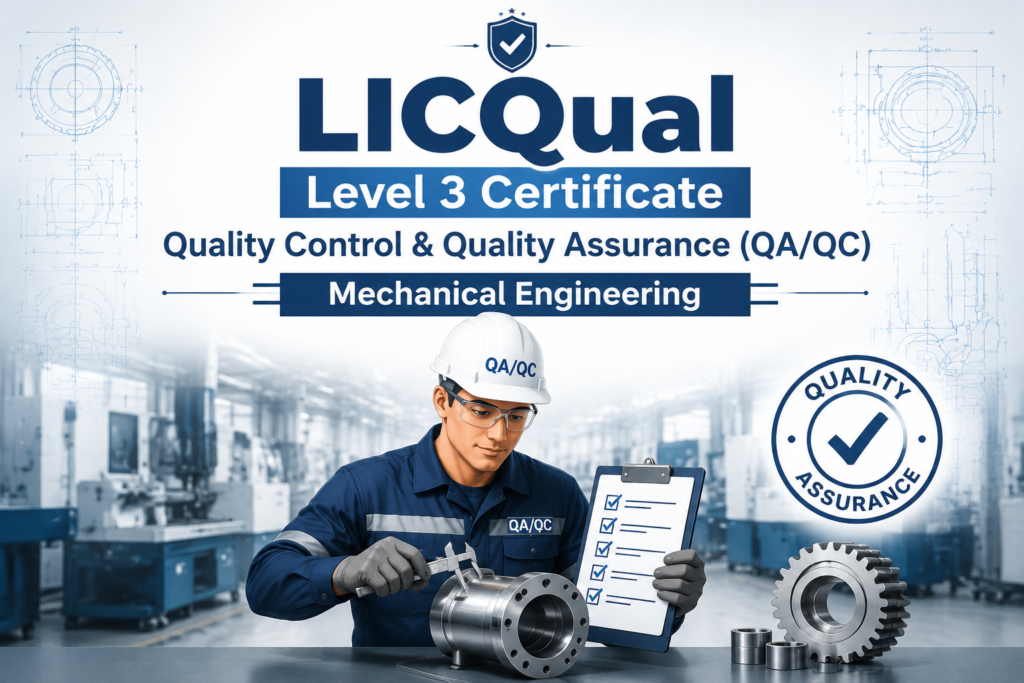
LICQual Level 3 Certificate in Quality Control and Quality Assurance (QA/QC) in Mechanical Engineering

The LICQual Level 3 Certificate in Quality Control and Quality Assurance (QA/QC) in Mechanical Engineering is a professional qualification designed...

Intermediate 5 weeks 6 lessons 6 quizzes
Overview
Curriculum 12
Instructor

What You Will Learn

The LICQual Level 3 Certificate in Quality Control and Quality Assurance (QA/QC) in Mechanical Engineering develops essential skills in mechanical quality control, inspection, testing, materials, and manufacturing processes. Learners will gain practical knowledge to support QA/QC activities in engineering workplaces.

  • Understanding the principles of quality control and quality assurance in mechanical engineering.
  • Identifying different engineering materials and understanding their properties affecting product quality.
  • Understanding the role of material selection in mechanical product design and manufacturing.
  • Learning key manufacturing processes including casting, forging, machining, welding, and additive manufacturing.
  • Evaluating how manufacturing processes influence material properties and product performance.

The LICQual Level 3 Certificate in Quality Control and Quality Assurance (QA/QC) in Mechanical Engineering is a professional qualification designed to develop essential knowledge and practical skills required for quality inspection, quality assurance processes, and quality control management within mechanical engineering environments. This course introduces learners to internationally recognised QA/QC principles, inspection techniques, engineering documentation, testing procedures, and quality improvement practices used across mechanical industries.

Quality control and quality assurance are critical components of modern mechanical engineering projects, ensuring that materials, components, fabrication processes, installations, and finished products meet required specifications, safety standards, and customer expectations. This certificate provides learners with a strong foundation in mechanical QA/QC systems, enabling them to understand how engineers and quality professionals monitor production activities, identify defects, implement corrective actions, and maintain consistent engineering quality.

Developed from the perspective of an experienced QA/QC Mechanical Engineer Specialist, this course focuses on the practical application of quality principles in industries such as manufacturing, oil and gas, construction, power generation, automotive, marine, and industrial engineering. Learners will explore quality management concepts, inspection methods, mechanical testing, non-destructive testing awareness, welding quality control, material inspection, measurement techniques, and quality documentation systems.

The LICQual Level 3 Certificate in Quality Control and Quality Assurance (QA/QC) in Mechanical Engineering is suitable for individuals who want to begin or enhance their career in mechanical quality inspection and engineering quality management. It supports learners in developing the technical understanding required to work effectively with engineering drawings, specifications, inspection plans, quality procedures, and compliance requirements.

This qualification is ideal for aspiring QA/QC Inspectors, Mechanical Quality Engineers, Inspection Technicians, Production Supervisors, Mechanical Technicians, Fabrication Professionals, and Engineering Graduates who want to build industry-relevant quality assurance skills. It also supports professionals working in mechanical engineering projects who need to strengthen their understanding of quality systems and inspection responsibilities.

Through this course, learners will gain the ability to understand QA/QC workflows, apply inspection principles, support quality audits, analyse quality issues, and contribute to continuous improvement within engineering operations. The programme helps develop the professional competence required to maintain high-quality mechanical engineering standards and improve reliability, efficiency, and safety across engineering projects.

The LICQual Level 3 Certificate in Quality Control and Quality Assurance (QA/QC) in Mechanical Engineering provides a valuable pathway for individuals seeking career progression in mechanical engineering quality management and prepares learners for further advanced studies in quality assurance, mechanical engineering inspection, and engineering project management.

Requirements

The LICQual Level 3 Certificate in Quality Control and Quality Assurance (QA/QC) in Mechanical Engineering is suitable for learners who want to develop basic knowledge and skills in mechanical engineering quality control, inspection, testing, materials, and manufacturing processes. The qualification is designed for individuals beginning their QA/QC journey or improving their understanding of engineering quality practices.

  • A basic educational qualification equivalent to secondary school level or a relevant vocational qualification.
  • Basic understanding of mechanical engineering principles and manufacturing processes.
  • Ability to understand technical documents, drawings, and engineering specifications.
  • Basic mathematical skills for measurements and quality assessments.
  • Awareness of workplace health and safety practices.
  • Interest in developing skills in mechanical engineering QA/QC activities.

Section 1: Unit No 1: Introduction to Quality Control and Quality Assurance in Mechanical Engineering
2 items
This unit provides learners with a comprehensive understanding of the fundamental principles of Quality Control (QC) and Quality Assurance (QA) in Mechanical Engineering. It introduces the role of quality management in ensuring that mechanical components, equipment, manufacturing processes, and engineering activities meet required specifications, safety standards, and customer expectations. Learners will explore the differences between quality assurance and quality control, the importance of inspection systems, quality planning, documentation procedures, and compliance requirements within mechanical engineering environments.nnThrough this unit, learners will develop essential knowledge of QA/QC practices used in industries such as manufacturing, fabrication, maintenance, automotive, energy, and industrial engineering. The unit focuses on how quality professionals identify defects, control production processes, implement corrective actions, and support continuous improvement. By understanding quality principles, inspection methods, and industry-based quality systems, learners will build a strong foundation for progressing into professional QA/QC roles within mechanical engineering projects.
Lesson No 1: Introduction to Quality Control and Quality Assurance in Mechanical Engineering
Quiz No 1: Introduction to Quality Control and Quality Assurance in Mechanical Engineering
Quiz
Section 2: Unit No 2: Mechanical Engineering Quality Management Systems (QMS)
2 items
This unit provides learners with a comprehensive understanding of Quality Management Systems (QMS) and their importance within mechanical engineering industries. It introduces the principles, structures, and processes used by organisations to establish effective quality systems that ensure mechanical products, manufacturing processes, and engineering operations consistently meet required standards and customer expectations. Learners will explore how QMS frameworks support quality planning, documentation control, process improvement, risk management, auditing, and compliance with international quality requirements such as ISO-based management practices.nnThrough this unit, learners will develop knowledge of how Quality Management Systems are implemented across mechanical engineering environments, including manufacturing, fabrication, maintenance, and industrial production. The unit focuses on the role of QA/QC professionals in managing quality procedures, monitoring performance, controlling non-conformities, and supporting continuous improvement. By understanding QMS principles and applications, learners will gain the foundation required to contribute effectively to professional quality management activities and improve the reliability, safety, and efficiency of mechanical engineering operations.
Lesson No 1: Mechanical Engineering Quality Management Systems (QMS)
Quiz No 2: Mechanical Engineering Quality Management Systems (QMS)
Quiz
Section 3: Unit No 3: Inspection and Testing Techniques in Mechanical Engineering
2 items
This unit provides learners with a comprehensive understanding of the inspection and testing techniques used to maintain quality, reliability, and safety in mechanical engineering. It introduces the principles of systematic inspection throughout the manufacturing, fabrication, assembly, and maintenance processes, enabling learners to identify defects, verify dimensional accuracy, and ensure compliance with engineering drawings, technical specifications, and recognised industry standards. The unit highlights the importance of quality assurance and quality control practices in delivering dependable mechanical products and systems that meet customer and regulatory requirements.nnLearners will explore a variety of inspection methods, measurement instruments, and testing procedures, including visual inspection, dimensional inspection, destructive testing, and non-destructive testing (NDT) techniques. The unit also covers the selection and calibration of inspection equipment, interpretation of test results, documentation of inspection findings, and reporting of quality issues. By combining theoretical knowledge with practical engineering applications, learners will develop the competence to perform accurate inspections, support continuous quality improvement initiatives, minimise production defects, and contribute to the successful delivery of high-quality mechanical engineering projects.
Lesson 1: Inspection and Testing Techniques in Mechanical Engineering
Quiz No 3: Inspection and Testing Techniques in Mechanical Engineering
Quiz
Section 4: Unit No 4: Non-Destructive Testing (NDT) in Mechanical Engineering
2 items
Non-Destructive Testing (NDT) is a vital quality control and inspection approach used in mechanical engineering to evaluate the integrity, reliability, and safety of materials, components, and structures without causing any damage or affecting their future usability. This unit introduces learners to the fundamental principles, techniques, and applications of NDT methods used across industries such as oil and gas, manufacturing, aerospace, power generation, construction, and heavy engineering. Learners will explore how techniques including Visual Testing (VT), Ultrasonic Testing (UT), Radiographic Testing (RT), Magnetic Particle Testing (MT), and Dye Penetrant Testing (PT) are applied to identify surface and internal defects, verify material quality, and ensure compliance with engineering specifications and international standards.nnThis unit develops essential knowledge and practical understanding of how NDT supports Quality Assurance (QA) and Quality Control (QC) processes in mechanical engineering. Learners will examine the role of NDT in defect detection, preventive maintenance, product reliability, and safety management while understanding inspection procedures, acceptance criteria, reporting requirements, and industry best practices. By completing this unit, learners will gain the ability to understand how non-destructive examination techniques contribute to maintaining mechanical system performance, reducing operational risks, and ensuring that engineering products meet required quality standards and customer expectations.
Lesson No 1: Non-Destructive Testing (NDT) in Mechanical Engineering
Quiz No 4: Non-Destructive Testing (NDT) in Mechanical Engineering
Quiz
Section 5: Unit No 5: Root Cause Analysis (RCA) and Problem-Solving in Mechanical Engineering
2 items
Root Cause Analysis (RCA) and problem-solving are essential disciplines in mechanical engineering that enable professionals to identify the underlying causes of equipment failures, quality defects, and process inefficiencies rather than simply addressing their visible symptoms. This unit introduces learners to structured investigative techniques used in quality assurance and quality control (QA/QC) to analyse mechanical failures, production issues, and maintenance challenges. Learners will explore industry-recognised RCA methodologies such as the 5 Whys, Fishbone (Ishikawa) Diagram, Pareto Analysis, and Fault Tree Analysis, developing the skills needed to perform systematic investigations and make evidence-based decisions that improve product quality and operational performance.nnThroughout this unit, learners will gain practical knowledge of applying problem-solving frameworks to real-world mechanical engineering scenarios, including manufacturing, fabrication, maintenance, inspection, and equipment reliability. The unit emphasises the importance of collecting accurate data, identifying contributing factors, implementing effective corrective and preventive actions (CAPA), and verifying the effectiveness of solutions. By mastering Root Cause Analysis techniques, learners will be equipped to minimise recurring failures, enhance workplace safety, improve production efficiency, ensure compliance with engineering standards, and contribute to continuous improvement initiatives across a wide range of mechanical engineering environments.
Lesson No 1: Root Cause Analysis (RCA) and Problem-Solving in Mechanical Engineering
Quiz No 5: Root Cause Analysis (RCA) and Problem-Solving in Mechanical Engineering
Quiz
Section 6: Unit No. 6: Materials and Processes in Quality Control for Mechanical Engineering
2 items
Materials and processes play a fundamental role in mechanical engineering quality control because the performance, reliability, and service life of mechanical components depend heavily on correct material selection, manufacturing processes, and inspection practices. In modern QA/QC systems, mechanical engineers must understand material properties, manufacturing techniques, and process controls to ensure that components meet engineering specifications, customer requirements, and international quality standards. Effective control of materials and processes helps prevent failures caused by incorrect material selection, manufacturing defects, dimensional inaccuracies, and improper processing methods.nnThis unit provides learners with essential knowledge of how materials and mechanical processes influence product quality throughout the engineering lifecycle. It explores the importance of material identification, testing methods, manufacturing process control, quality inspection techniques, and compliance verification. By understanding the relationship between materials, production processes, and quality requirements, QA/QC Mechanical Engineers can make informed decisions, improve product reliability, reduce defects, and support continuous improvement within mechanical engineering industries.
Lesson No 1: Materials and Processes in Quality Control for Mechanical Engineering
Quiz No 6: Materials and Processes in Quality Control for Mechanical Engineering
Quiz

Aqsa

Instructor

LICQual Level 3 Certificate in Quality Control and Quality Assurance (QA/QC) in Mechanical Engineering
$200.00
  • 5 weeks
  • 6 lessons
  • 6 quizzes
  • Lifetime access